Leave Your Message
Choosing a Courtyard Sprinkler in 2026 requires more than comparing prices and spray distances. A small courtyard may contain stone paving, narrow planting beds, children’s play areas, and fragile pots. Each surface changes how water should move. A sprinkler that performs well on open grass may create puddles beside a wall.
Dr. Charles M. Burt, a respected irrigation engineer and founder of the Irrigation Training and Research Center, defines irrigation clearly: “Irrigation is the controlled application of water through man-made systems to supply water requirements not satisfied by rainfall.” This principle remains useful in 2026. A reliable Courtyard Sprinkler should deliver water deliberately, not simply spray more water. Look for adjustable coverage, pressure control, durable materials, and compatibility with smart timers. Flow sensors and weather-based controllers can reduce waste, but they cannot correct poor placement.
Measure the courtyard first. Note shaded corners, wind exposure, drainage problems, and plant water needs. Then compare rotor, oscillating, micro-spray, and drip-compatible options. Micro-sprays may suit dense borders. Compact rotors can cover wider spaces. Drip systems often protect walls and reduce evaporation.
My own assessment would not ignore installation quality. Even an advanced sprinkler can fail when its filter clogs or its nozzle points toward paving. That detail is easy to miss. It should not be.
This guide examines practical selection criteria for 2026, including efficiency, maintenance, coverage, noise, controls, and long-term operating cost. The best choice is rarely the most powerful model. It is the one that matches the courtyard’s real conditions.
How to Choose a Courtyard Sprinkler in 2026?
Understanding Courtyard Sprinkler Types and Their Uses
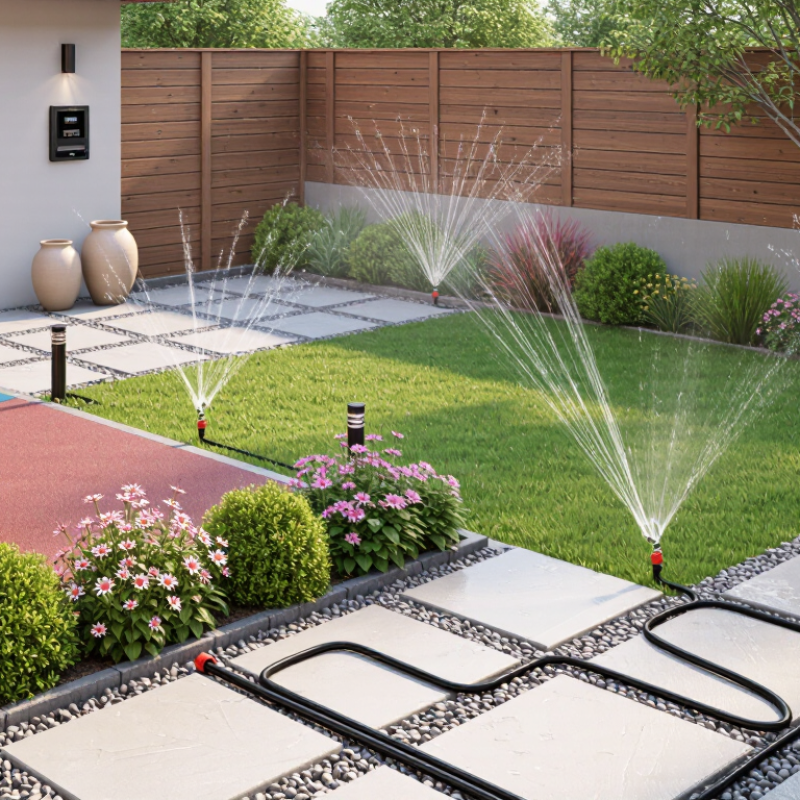
Courtyard sprinklers work best when their spray matches the space. Fixed spray heads suit small, square planting beds. They deliver a steady fan of water. Rotary nozzles move slowly and use larger droplets, reducing mist around paved areas. Impact sprinklers cover wider courtyards, but their strong streams may disturb soil or splash walls. Micro-sprinklers serve flower beds and containers with gentle, low-volume coverage. Drip systems are not sprinklers, yet they often perform better around shrubs.
According to the U.S. Environmental Protection Agency’s WaterSense irrigation guidance, inefficient landscape systems can waste up to 50% of applied water. The agency also estimates outdoor irrigation uses nearly 9 billion gallons daily in the United States. These figures make nozzle selection more important than appearance. Measure the courtyard first. Check pressure, shade, wind, and plant height. A narrow strip may need short-radius spray heads. A windy corner may need low-angle rotary nozzles.
I have seen courtyard layouts fail because every zone used one sprinkler type. It looked tidy, but dry edges appeared beside soaked paving. That choice needs reconsideration. Use separate zones for lawn, shrubs, and containers. Add a rain or soil-moisture sensor where practical. The Irrigation Association recommends matching precipitation rates across each zone. Keep that principle visible during installation. Small courtyards punish poor spacing. Test each head with empty paving nearby. Adjustments often matter more than expensive equipment.
| Sprinkler Type | Best Courtyard Use | Typical Coverage Pattern | Typical Throw or Reach | Typical Flow Range* | Main Advantages | Limitations | Recommended Installation |
|---|---|---|---|---|---|---|---|
| Fixed Spray Sprinkler | Small lawns, narrow planting beds, and compact square courtyards | Fixed fan or part-circle spray | Approximately 2–5 m radius | About 4–15 L/min per head | Simple layout, affordable, and effective for short distances | Higher application rate; more sensitive to wind and overspray | Install flush with the soil and use matched spray angles |
| Rotary Spray Nozzle | Mixed-use courtyards with lawn strips and ornamental borders | Multiple rotating streams | Approximately 4–8 m radius | About 1–8 L/min per nozzle | Lower flow than standard sprays and improved wind resistance | Requires adequate pressure; rotating streams may clog if water is dirty | Use on pop-up bodies and keep filtration clean |
| Gear-Drive Rotary Sprinkler | Medium-sized open courtyards and rectangular lawn areas | Rotating full-circle or adjustable part-circle | Approximately 6–12 m radius | About 5–25 L/min per head | Large coverage area and adjustable arc control | May be excessive for very small spaces; needs sufficient pressure | Position heads for head-to-head coverage and avoid blocking by furniture |
| Impact Sprinkler | Open courtyards where long-range watering and durable components are needed | Pulsating rotating stream | Approximately 8–15 m radius | About 10–40 L/min per head | Durable, suitable for larger zones, and often tolerant of moderate water debris | Visible above-ground movement, noise, and possible overspray | Use only where the larger spray radius will not wet walls, paths, or seating |
| Oscillating Sprinkler | Temporary watering of rectangular lawns or newly seeded areas | Side-to-side rectangular spray | Typically 5–15 m along the spray direction | Commonly 8–25 L/min | Portable, easy to reposition, and suitable for gentle lawn watering | Hoses create trip hazards; coverage changes with water pressure | Place on level ground and remove after use in pedestrian areas |
| Micro-Spray Sprinkler | Flower beds, ground covers, shrubs, and densely planted containers | Fine spray, bubbler spray, or small fan pattern | Approximately 0.5–3 m radius | About 0.5–6 L/min per emitter | Targets planting areas with low flow and flexible spacing | Fine droplets can drift; small passages require regular cleaning | Install below or between plant foliage and add filtration |
| Dripline Irrigation | Hedges, shrub borders, raised beds, and water-sensitive planting zones | Point-by-point or continuous soil-line wetting | No spray radius; emitter spacing commonly 20–60 cm | Commonly 1–4 L/hour per emitter | Very low evaporation and minimal overspray onto paving | Not suitable for evenly watering large open lawns; vulnerable to clogging | Use a pressure regulator, filter, flush end, and mulch where appropriate |
| Bubbler Irrigation | Individual trees, large shrubs, and deep-rooted plants | Localized low-volume stream or flooding pattern | Typically 15–60 cm around the outlet | About 1–8 L/min per bubbler | Delivers water directly to the root zone and is easy to inspect | Can cause runoff or soil erosion if the flow exceeds soil infiltration | Use basins or multiple low-flow points on sloped or compacted soil |
*Flow and coverage figures are typical planning ranges, not guaranteed performance values. Actual results depend on nozzle design, water pressure, pipe size, spacing, wind, and elevation. For efficient lawn irrigation, arrange spray heads for approximately head-to-head coverage and avoid watering paved surfaces.